Pixel Pond

Helping Pixel Pond develop trust and listen to their users

Fonts used:
- Azeret Mono
Introduction
Company Context and Brief
This project was for Pixel Pond, a growing business in London specialising in recruitment in the tech sector. They were looking to expand the business into career coaching and were exploring fresh approaches to design to help engage potential customers. The deliverables included an initial prototype, which could then be further developed.
My Role
I worked within a small team, collaborating on research and interpreting the data. I produced my own individual design solution, which was then presented to the client (along with each member of the team).
The Research
What is the value of a career coach?
The initial hypothesis from discussions with the founder was that there was a lack of awareness of career coaching in the UK market. This meant demonstrating value to customers was crucial. Once a client had booked a session and built a relationship with the career coach, this would happen more naturally. What was crucial was persuading them to book that first session. Conducting detailed interviews, we investigated participants' awareness of career coaching. We explored what would make a career coach valuable to them, identifying any previous experience with career coaches and what they had found beneficial as well as what was not.
The findings: The value of listening and giving customers a choice
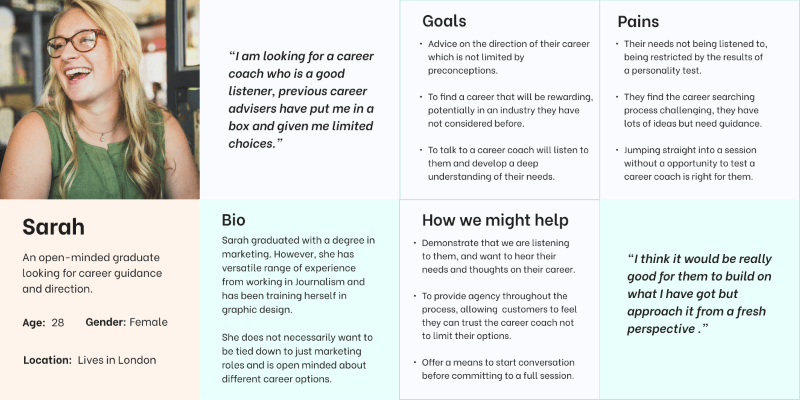
Our research showed that there was awareness of career coaches, but previous experiences with them had been mixed, which put them off engaging with the service again. What they were looking for in a career coaching service was someone who would listen carefully to their needs and provide a sense of agency and choice throughout the process. There was also the desire to build the relationship with a career coach at their own pace. They didn't want to be rushed into immediately booking a session; they wanted to be able to 'break the ice' first and have some initial back and forth before committing to further sessions.
Personas and Empathy Maps

The Ideation Process
How do you show that you are listening?
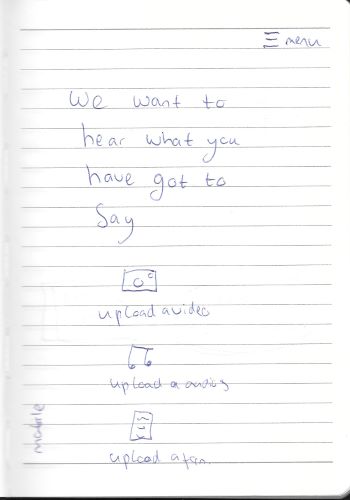
The research revealed the range of backgrounds and experiences of people looking for a career coach. What brought them together was the importance of a service listening to their needs. How do you reflect this within a design? I was led towards providing a practical means of listening to their needs by giving them a choice of uploading a video file, audio file, or filling out a form before booking a session. This would also fulfil the criteria of giving users choice and a sense of agency; they could start the conversation how they liked at their own pace before booking a session.
User flow

My initial user flow revealed that the challenge of offering a lot of choices can create a complex user experience. I needed a means of simplifying the process. (Download full user flow )
Initial sketches
I felt conveying information visually through icons would be efficient and help simplify the user experience. Combining visuals with simple, clear descriptions of each step in the process was also inclusive. It provided users with two different means of understanding the information and being able to proceed. Reducing text would also aid users with Dyslexia or ADHD.
Refining the design
The same brand, a new approach
While incorporating the existing brand identity (colors, logo, fonts), the use of icons and the simplicity of the design (not using images) reflected a fresh approach. I felt that this was needed to focus tightly on creating as frictionless a user experience as possible. The research revealed that value would be placed on being able to share information, feel listened to, and flexibly engage in the service. I wanted nothing else to distract from this. It was also crucial to be welcoming. I hoped the friendly, rounded icons, copy, and visual approach of the design would achieve this. The aim was to gently and seamlessly start the conversation with customers, which would lead to further sessions being booked in the future.


The Outcome
Positive feedback from the client
The client felt I had a strong understanding of what he was trying to achieve with the business, and this was expressed through my design. He appreciated how this design prioritized convenience for his clients, i.e., being able to quickly upload an audio file or fill out a form while commuting to work. It also improved the efficiency on his end as he could go into meetings already well-informed. The next steps would involve managing the processes after the user has submitted their information. We remained in contact, and he said he would be open to exploring the ideas I had put forward.
My Reflections
Improvements I would like to make to this design
I could go further in highlighting the benefits of a career coach to users. On the landing page, I could have an introductory video or short animation. The client's feedback on considering the user experience after submission could be partly addressed with information on the last submission page, outlining the next steps of the process. In future designs, I would look at further developing integration with the recruitment side of the Pixel Pond business.
What I learned from the process
A key insight was the flexibility and fluidity of the UX process. I revisited my user flow and refined it to help improve my overall design. I learned that patience and being able to take a step back can help you move forward towards a better solution. I also learned that I could adapt to a leadership role, although I was initially hesitant to lead the meeting with a client. I found that taking on the responsibility helped increase my confidence and communication with my team throughout the process.